Use-of-force incidents
Use of force is the means of compelling compliance or overcoming resistance to an officer's efforts to protect life or property, or take a person into custody.
OpenPDI has standardized over 50,000 use-of-force incident reports from data submitted to the Police Data Initiative, which lets us explore why, how, and where officers use force across the U.S.
Reasons for using force
Share of 29,411 incidents
“resisting arrest”, “necessary to effect arrest”
“assaulting citizen(s)”, “subject combative”, “battery on police officer”
“refuse verbal commands”, “subject non compliant”
“fleeing”, “flight from an officer”, “escape”
“weapon display”, “weapon exhibited”
“other”, “to restrain for subject’s safety”
Force by behaviour
The type of force used in response to different behaviours. “Impact” covers non-lethal weapons such as batons and bean-bag rounds; darker cells are higher counts.
| Force | Resistance | Active aggression | Non-compliance | Fleeing | Weapon display | Other |
|---|---|---|---|---|---|---|
| Physical | 3,598 | 4,315 | 22 | 20 | 131 | 1,163 |
| Weapon | 233 | 247 | 3 | 4 | 103 | 103 |
| Electric | 292 | 208 | 8 | 0 | 24 | 49 |
| Chemical | 169 | 129 | 3 | 7 | 1 | 35 |
| Impact | 54 | 45 | 2 | 2 | 1 | 7 |
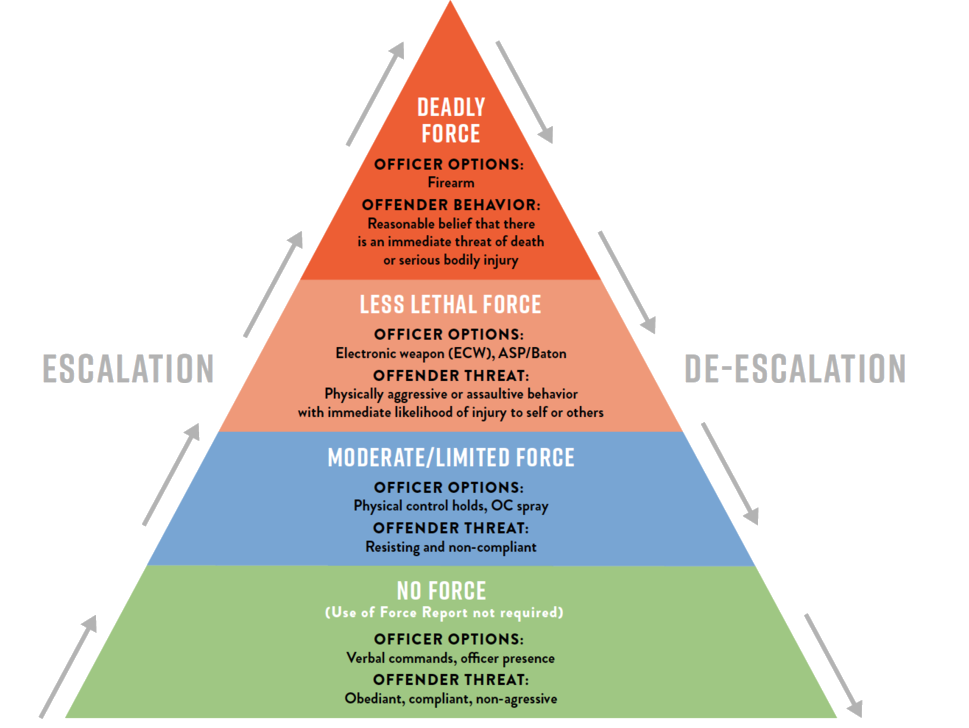
The force continuum
Officers are typically trained to use the least amount of force necessary to reduce the immediate threat — from no force (verbal commands, presence) to deadly force. Exact policies vary by department, but the recommended progression generally resembles the continuum below (courtesy of the Use of Force Project).
To run your own analysis, see the open-source Python library for working with data standardized by OpenPDI.
OpenPDI is an unofficial, open-source effort to document, standardize, and present data on police activity in the U.S. Data comes from public releases via the Police Data Initiative. Source ↗